
Starting power you can trust on callout morning
Generator battery care is the planned upkeep of the starting batteries that spin the engine over, feed the control circuit and give the unit a clean first crank after a power interruption. On standby and prime sets in offices, factories, warehouses, healthcare sites and process plants, the battery bank is one of the first places we look when a generator is slow to start, throws a low voltage alarm or struggles after long idle periods.
On a maintenance contract, our work covers the battery itself, the terminals, clamps, hold-downs, charger output and the signs of age that show up before failure. In Gauteng heat, coastal humidity in Durban, and dusty yards in places like Polokwane or Centurion, a battery can degrade through corrosion, sulfation and poor charging long before it looks faulty.
- 24 V DC and 12 V DC starting systems
- Flooded lead-acid, sealed lead-acid and AGM starting batteries, matched to the set
- Single-battery and battery-bank arrangements
- Visual condition checks, voltage readings and charger verification
What our battery care contract covers at site
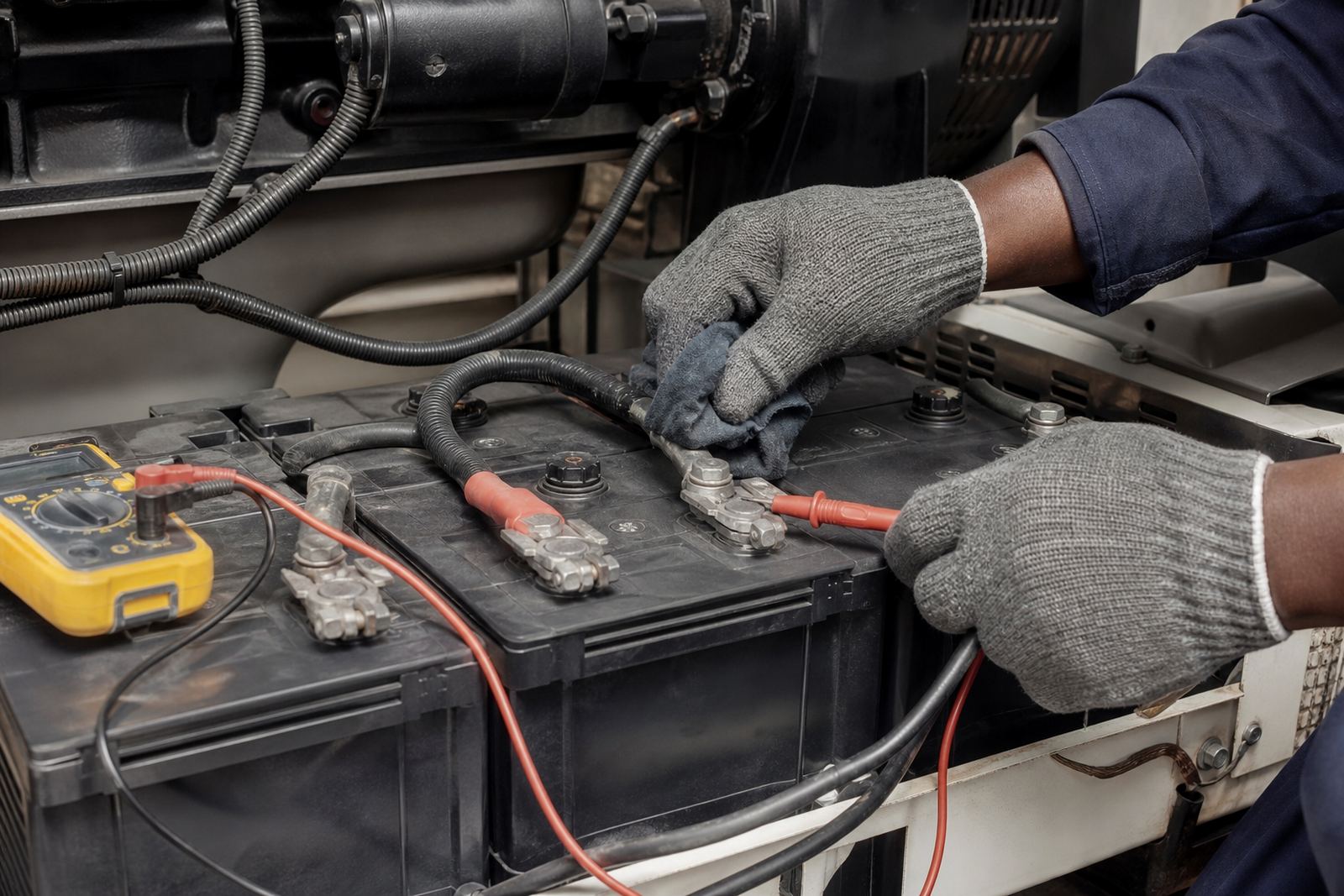
Battery care is not only about changing a flat unit. We check how the starting battery is being charged, whether the terminals are clean and tight, and whether the battery is still holding enough capacity for repeated starts. If your set runs weekly test cycles, sits for long periods, or starts under heavier load after a municipal outage, we plan the battery checks around that duty cycle.
RelGen can include battery care inside a wider generator service contract, or handle it as a focused maintenance item for sites with a history of starting faults. Our technicians record the condition of each battery, note any swelling, leakage or heat damage, and flag sets that need replacement planning before the battery fails on a wet Monday morning when the building is full.
- Battery voltage and state-of-charge checks
- Charging system confirmation under running conditions
- Terminal cleaning and corrosion removal
- Hold-down, cable and lug inspection
- Replacement scheduling based on condition, not guesswork
Electrical work on generator charging circuits and control systems must be done by qualified people in line with local regulations, and we keep the battery side of the work within that requirement.
Sizes and battery options we handle
There is no single battery size that suits every generator. The correct choice depends on engine size, starter demand, battery tray space, ambient temperature and how often the set is expected to start. Some sites use one larger starting battery, while others use a paired battery arrangement or a bank configured for the control panel and starter motor needs.
For planning, we work with the physical dimensions, terminal orientation and battery chemistry that suit the generator room or canopy enclosure. On cramped plant rooms, tray length and cable reach matter. On outdoor installs near the coast, sealed construction and corrosion control become more important. If the unit is part of a rental fleet or a busy production site, we also look at whether the batteries should be kept on a shorter changeout cycle.
- Battery case size to fit the tray and enclosure
- Terminal type and position
- Rated capacity for the starter demand
- Cold cranking performance suited to the engine
- Replacement intervals suited to site conditions
Where battery care matters most
Battery problems show up fastest on generators that are expected to start immediately and repeatedly. Manufacturing lines, cold rooms, data rooms, warehouses, shopping centres, clinics, construction compounds and water-related sites all depend on a clean start when the mains fail. Prime power sets working hard through load shedding or remote-site running also need stronger battery discipline than a standby set that hardly moves.
RelGen services sites in Midrand, Johannesburg, Pretoria, Centurion, Sandton, Durban, Cape Town and Polokwane, with contract support for businesses across South Africa. We are used to the practical issues that affect battery life, from heat and vibration to poorly ventilated battery compartments, long idle periods and neglected charger settings.
When a site has repeated start failures, we look beyond the battery itself. Loose connections, weak charging output, old cables or a dirty battery tray can all reduce starting reliability. That is why battery care works best as part of a scheduled generator maintenance plan rather than a once-off repair.
Cleaning, charging checks and replacement planning
Clean batteries last longer and give clearer warning signs. We remove build-up around the terminals, check for white or green corrosion, inspect for cracked cases and make sure the battery sits properly on its tray. We also confirm that the charger is maintaining the correct float condition, because overcharging and undercharging both shorten service life.
For many businesses, the most useful part of battery care is replacement planning. Rather than waiting for a dead battery on a rainy Tuesday, we track age, service condition and test results so that replacements can be scheduled with the rest of the site maintenance. This helps with procurement, stock holding and shutdown planning where access is limited.
- Terminal cleaning and anti-corrosion attention
- Electrolyte level checks on serviceable batteries
- Charger output and float behaviour checks
- Replacement timing aligned to site operations
Installation and fitting details that need to be right
Replacing a starting battery is not just a swap of old for new. The battery must be secured correctly, connected with the right polarity and installed with cables that are in good condition. On some sets, the battery bank is in a tight enclosure or mounted low, so access, lifting and safe handling need proper planning. If the battery is in a plant area with dust, heat or fumes, ventilation and cable routing must also be considered.
We confirm the battery tray dimensions, total system voltage, starter demand, terminal layout and physical access before ordering. For sites with generator rooms that are inspected by landlords, insurers or internal safety teams, neat fitment and clear labelling can save time during audits. If changeover switch checks are part of the contract, we also make sure the generator start sequence and battery condition are assessed together, because a weak battery can mask another fault in the starting circuit.
- Battery tray size and mounting method
- System voltage: 12 V, 24 V or other configured arrangement
- Terminal orientation and cable length
- Access path for fitting and future replacement
- Condition of charger, cables and starter connections
What to confirm when you order battery care
To match the right battery care plan to your set, it helps to confirm the generator make and model, engine type, current battery size, site location and how often the unit is expected to start. If the generator runs on a contract with routine servicing, send the latest service record as well, because that tells us whether charging faults, cable issues or repeated low-voltage alarms have already been noted.
It also helps to know whether the set is standby only or used as prime power, and whether it serves a business in Johannesburg, Durban, Cape Town, Pretoria, Polokwane or another area where climate and access conditions differ. Our team in Midrand coordinates service contracts through Thabo Engelbrecht, with support from Naledi Shezi, Johan Matlala, Ayanda Khoza, Muneerah Daniels, Sibusiso Wessels and Rikus Botha. Clients reach us through the enquiry form on our contact page, and we use that information to set the right inspection frequency and replacement plan.
Battery care works best when it is documented, measured and repeated on schedule. That is how you avoid the awkward surprise of a set that sounds healthy one week and will not crank the next.
Key facts
| Product type | Generator starting battery care contract |
|---|---|
| Typical systems | 12 V and 24 V starting circuits |
| Battery formats | Flooded lead-acid, sealed lead-acid, AGM |
| Core checks | Voltage, charger output, terminals, cables, hold-downs |
| Service use | Standby and prime generators |
| Service areas | Midrand, Johannesburg, Pretoria, Durban, Cape Town, Polokwane |