Why the exhaust gets attention before the trouble starts
On a working generator, the exhaust line carries hot gases, vibration and a fair amount of stress every time the set starts. Over time, clamps loosen, brackets work themselves free and joints begin to show signs of movement. If that is left alone, the result can be rattling, fumes in the wrong place, or heat damage around nearby cabling and walls.
That is why exhaust condition is part of routine servicing, not an afterthought. A sound exhaust system helps the set run cleaner and safer, and it also protects people who work near the machine room. In a Midrand warehouse with a generator running through load-shedding or during peak production, a small exhaust fault can become a bigger repair very quickly.
What we look for when the generator is off and cooling
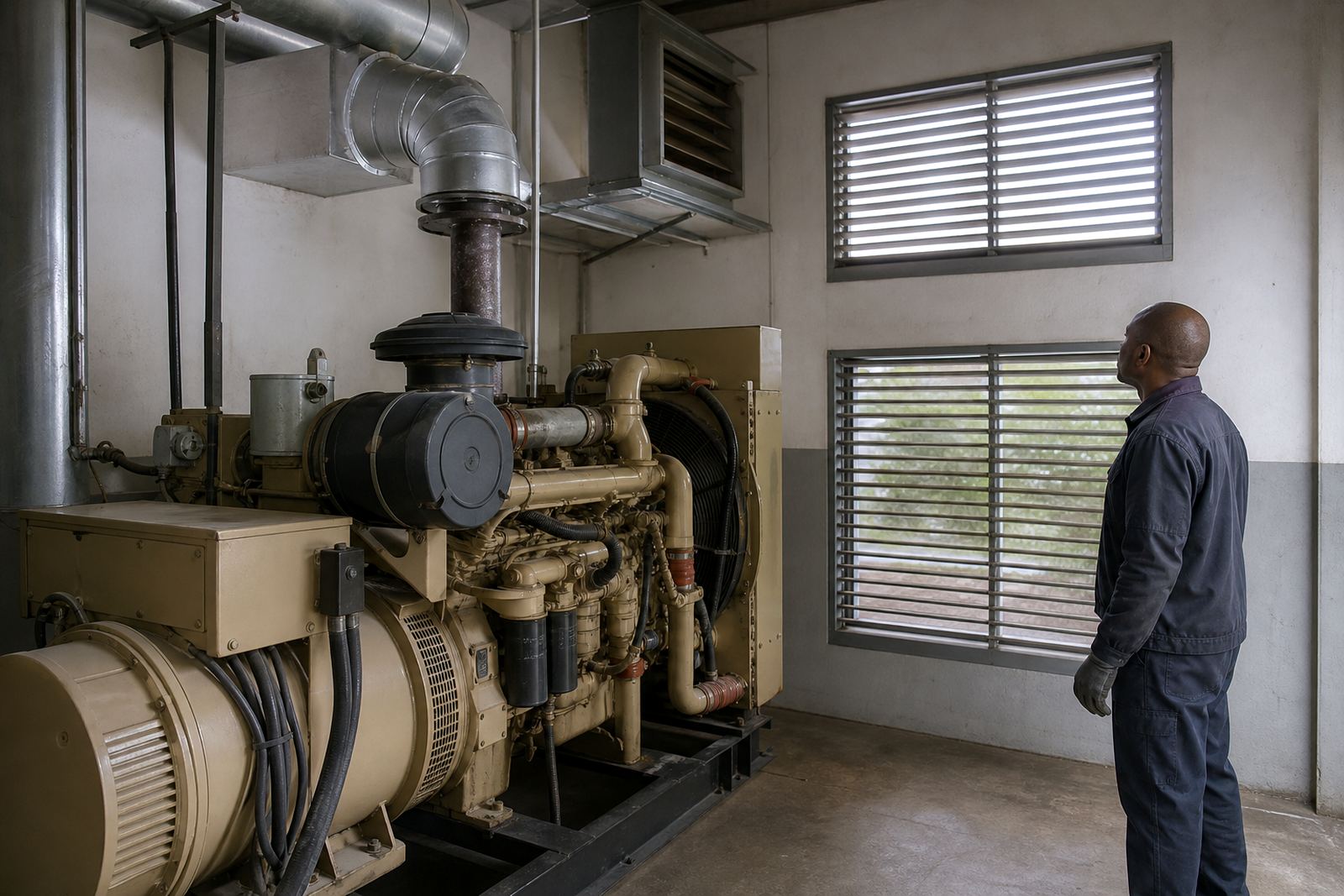
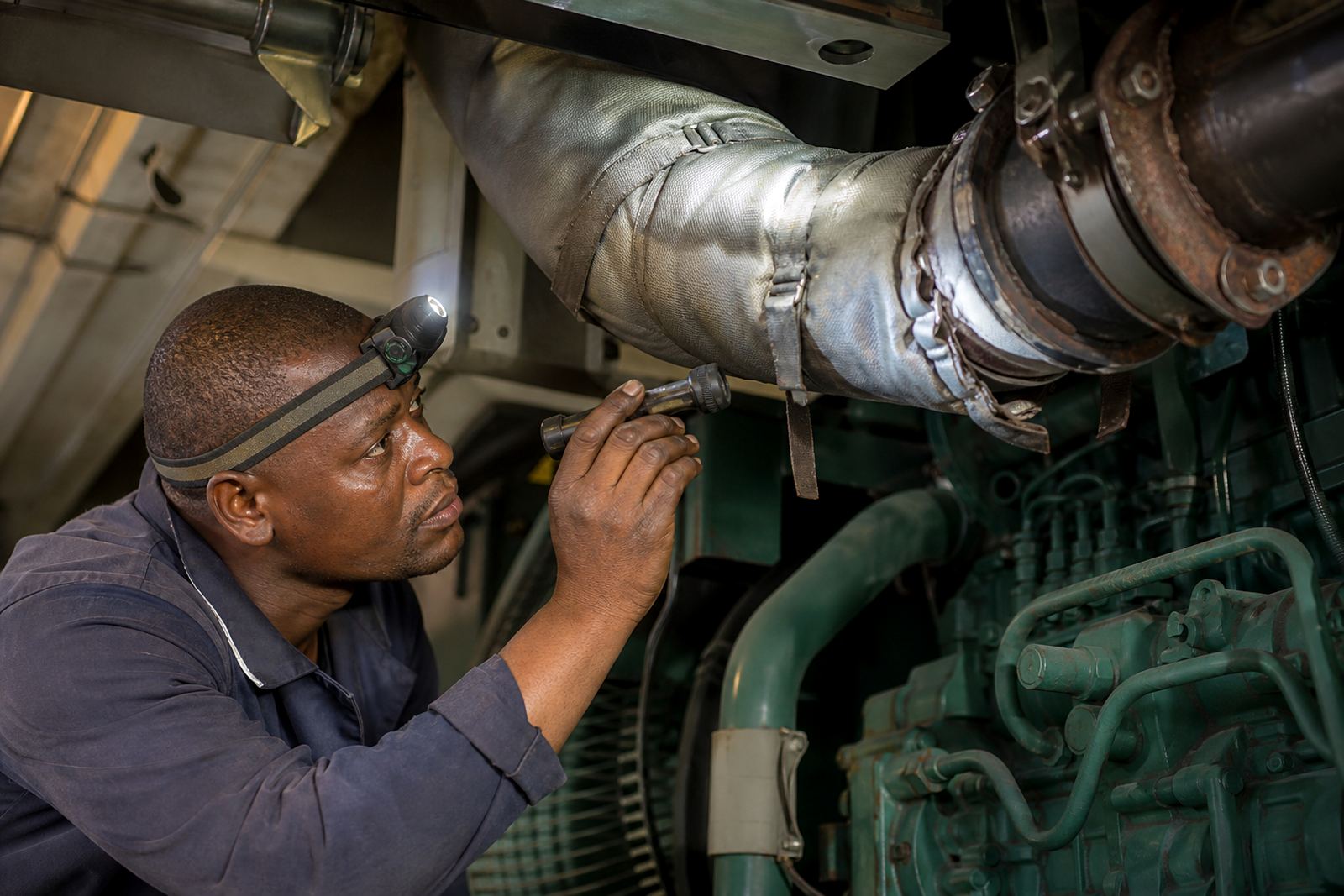
Before any close inspection, the set must be shut down and allowed to cool. Exhaust parts stay hot for longer than people expect, especially on enclosed standby units. Once it is safe, we inspect the full visible run from the engine outlet to the point where gases are discharged outside the building.
- Loose or missing bolts at flanges, couplings and hangers
- Cracked brackets, sagging supports, or signs of movement at fixing points
- Black soot marks that can point to a leak at a joint
- Heat discolouration on nearby surfaces, insulation or cabling
- Rust, corrosion or thinning metal on outdoor sections exposed to rain and coastal air
In coastal areas such as Durban and Cape Town, we often see faster corrosion on external exhaust sections. Inland, the problem is often vibration and poor support after repeated starts. Both need attention before the next outage hits.
Fastening points carry more load than people think
The exhaust line is not just a pipe. It is a supported assembly, and every fixing point has to hold its share of weight while the generator is running. If one hanger fails or a bracket loosens, the whole line starts to move. That movement can crack a gasket, twist a joint, or put strain on the engine connection.
During maintenance contracts we check whether the fasteners are tight, whether the supports are aligned, and whether the mounting points are still doing their job. We also look at the clearance around the system. Pipes should not rub against walls, panels or other equipment when the set vibrates under load.
- Supports should keep the line steady without forcing it into a bend
- Flexible sections must not be stretched or compressed out of shape
- Fasteners need to stay secure after repeated starts and stops
- Any temporary repair should be treated as a warning, not a final fix
Signs that usually show up before a failure
Exhaust faults rarely appear without warning. The signs are often small at first, and a technician who sees them early can prevent a shutdown. We ask site staff to report anything that changes in sound, smell or heat around the generator area.
Common signs include a new knocking sound, a sharper exhaust note, visible smoke staining near joints, or a smell that seems stronger than usual around the plant room. In some cases the exhaust may still do its job, but the set will be running under unnecessary strain. That is when a planned service is cheaper than an emergency repair.
We saw this on a commercial site in Pretoria where the generator was used during evening peak periods. The unit was running fine by output, but a support clamp had loosened and the exhaust had started to knock against a steel frame. Nothing had failed yet, but the vibration had already marked the frame and started to work on the joint. A short repair during a scheduled visit stopped it becoming a callout at 2 am.
Why qualified electrical and mechanical work must stay separate and legal
Exhaust checks often sit alongside other generator work, but they are not treated in isolation. Electrical work on changeover systems, control circuits and associated wiring must be handled by qualified people under local regulations. Fuel and exhaust repairs also need proper care because heat, vapour and moving parts can create hazards if the job is rushed.
RelGen services standby and prime generators on maintenance contracts, and we keep the work within the correct scope for each task. If an exhaust issue is linked to another fault, such as poor starting, overheating or a control warning, it is traced properly rather than guessed at. That keeps the machine safer and the diagnosis cleaner.
- Do not tighten hot exhaust fittings by feel alone
- Do not run a unit with a suspected leak inside a closed room
- Do not move or modify supports without checking the full line
- Do not ignore repeated vibration after service
How routine checks fit into a maintenance contract
Exhaust checks work best as part of a planned service cycle, not only when someone hears a rattle. A good maintenance contract records what was found, what was tightened, and what still needs monitoring. That record matters when a site manager has to make decisions during power interruptions or a busy production week.
Our team in Midrand supports businesses across Johannesburg, Pretoria, Durban, Cape Town, Polokwane, Centurion and Sandton. For a manufacturing site near a busy freight route, or a retail depot with limited access after hours, planned exhaust inspection helps avoid disturbance to operations. It also supports cleaner handovers between shifts, because the next technician can see exactly what was done.
We also review service notes for repeat faults. If a clamp keeps loosening, or a hanger keeps failing, there is usually a reason in the layout, the vibration pattern or the condition of the supporting structure. That is where a proper inspection pays off, because it deals with the cause not just the symptom.