Why charging checks sit near the top of the list
The charging system does one plain but vital job: it keeps the starting battery ready so the set can crank when needed. If the battery is flat, sulphated or not receiving charge properly, the unit may show no warning until the site is already under pressure.
In Gauteng this often shows up after a few short outages, then a longer one on a wet Tuesday when a business in Midrand or Sandton needs backup power most. Coastal sites in Durban and Cape Town can have extra corrosion around terminals and clamps, so the same fault can develop faster there. A charging review gives you an early read on battery health, charging output and any weak links in the starting circuit.
Electrical work on generators should be handled by qualified people in line with local regulations, especially where switchgear, alternators and control wiring are involved. That keeps the inspection proper and helps avoid damage to control boards, starter motors and cabling.
What gets checked during a charging review
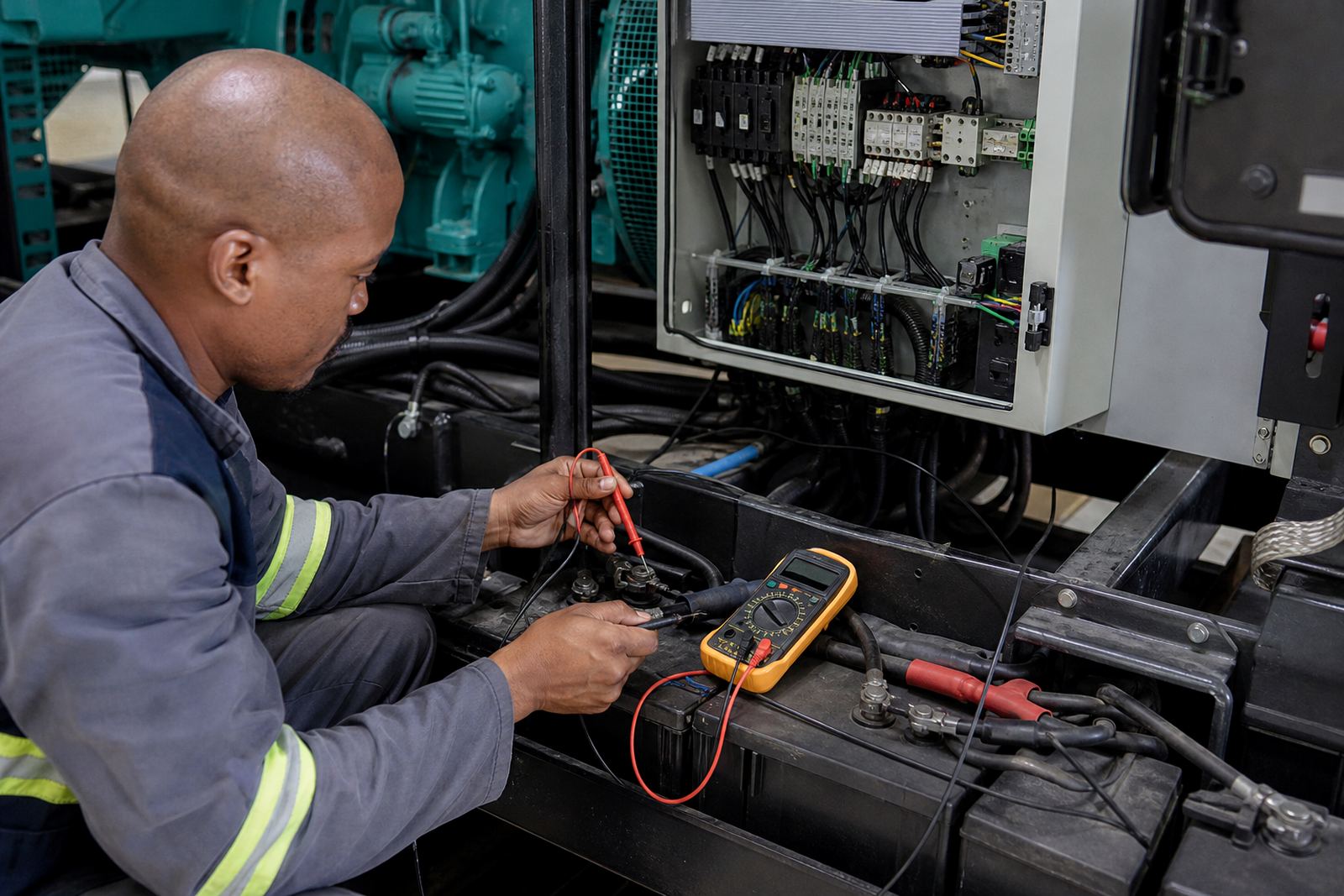
A proper charging check is more than a quick glance at the battery tray. We look at the battery condition, cable ends, charging voltage, belt condition where applicable, alternator or charger operation and any signs that the system is not holding charge as it should.
- Battery terminals cleaned and tightened
- Charging voltage measured under normal running conditions
- Cable insulation checked for heat damage or cracking
- Battery hold-downs and tray condition inspected
- Starter relay and related connections tested for secure contact
- Signs of leakage, swelling or corrosion noted for follow-up
If a site has a remote alarm panel or controller, we also check whether the charger fault or low battery alarm is appearing in the event log. That gives a useful trail when a team needs to understand whether the issue has been building for weeks or only started after a recent shutdown.
Where charging faults usually start
Many charging problems begin with small things that are easy to miss. A loose terminal, a tired battery, contaminated connections or a charger that is still running but not delivering the right output can all lead to starting trouble. Dust and heat also matter. In a plant room in Pretoria or a construction yard near Polokwane, fine dust can build up on battery tops and terminals, then mix with moisture and form a conducting path.
Common causes we see on maintenance contracts include:
- Old batteries that no longer hold a full charge
- Corroded clamps or damaged battery leads
- Flat batteries after repeated short test runs
- Faulty battery chargers or alternator charging issues
- Poor earthing or loose control wiring
- Vibration that works terminals loose over time
It is worth noting that a battery can still show some voltage and still fail under load. That is why a quick metre reading is not enough on its own. A practical technician checks the battery under real starting demand and looks at what happens when the engine turns over.
Load bank testing and charging health go together
Load bank testing is often thought of as a separate exercise, but it helps reveal charging issues too. A set can start, run and seem fine at light load, then show weak charging recovery after a longer test. If the battery charger is not restoring charge properly after the test, the next outage may catch the site out.
During service visits, we use the test period to see how the charging system behaves while the engine is running steadily and then after shutdown. That makes it easier to spot a charger that is slow to recover, a battery that is no longer accepting charge, or a system that is dipping below safe starting levels.
- Check battery recharge rate after test running
- Confirm alarms clear correctly once the system stabilises
- Look for repeated low-voltage events in the controller log
- Verify the charger resumes normal operation after an outage simulation
This matters on sites with frequent generator use, where a standby set may behave more like a daily operating asset than an emergency only machine.
Changeover switch checks and starting reliability
The charging system and the changeover arrangement are connected in practice, even if they are different parts of the installation. If the generator starts but the changeover does not operate correctly, the site still sits in the dark. Likewise, if the battery is weak and the engine fails to start, the switch never gets a chance to do its job.
We therefore check the changeover switch, control signals and start command path during scheduled servicing. The aim is to confirm that the generator receives the start request when supply fails, and that the charger keeps the battery ready for the next call. Where there are multiple panels or remote start functions, we test the sequence carefully so that a hidden fault does not remain behind a normal-looking front panel reading.
In places like Centurion and Johannesburg, where many businesses depend on automatic transfer for offices, warehouses and light manufacturing, a missed signal can create avoidable downtime. A charging review gives you a better chance of catching that before the next municipal interruption or planned shutdown.
A Midrand site example from a maintenance visit
On a routine service visit at a Midrand logistics site, the generator started but cranked slowly after two brief power interruptions in one week. Oil and filters were in order, coolant levels were fine and the fuel system had already been cleaned, so attention moved to the charging side. The battery was still showing voltage, but the terminals had a light white deposit and one clamp was slightly loose.
Once the terminals were cleaned and tightened, the charging output was rechecked and the unit settled into a proper charge cycle. The battery itself was near the end of its useful life and was flagged for replacement before the next heavy-use period. That small finding prevented a larger problem later, because a weak battery often gives a warning only once the site is already under strain.
These are the sorts of issues a planned visit is meant to catch. The cost is usually in time and attention, not in major parts, which is why service contracts make sense for businesses that cannot afford guesswork when the power drops.
Keeping the charging side dependable between visits
There are a few practical habits that help between maintenance calls. Site teams do not need to open panels or interfere with controls, but they can still spot early signs such as battery alarms, repeated failed starts or corrosion around visible terminals. If a generator has been sitting unused for a while, let the maintenance team know rather than waiting for the next scheduled date.
- Report any low battery or charger fault alarm promptly
- Keep the battery area clean, dry and accessible
- Do not allow unauthorised wiring changes near the starter circuit
- Log failed starts, even if the next attempt succeeds
- Ask for the charging side to be checked after any major outage or repair
For sites across Johannesburg, Pretoria, Durban, Cape Town, Polokwane and the surrounding areas, a well-timed charging check helps keep standby and prime generators ready for work. It is a small part of the service visit, but it can decide whether the set starts cleanly or leaves the site waiting.