Why the smallest battery can stop the biggest machine
On a generator set, the starter battery does one job: it must deliver enough current to crank the engine and let the control system do its work. If that battery is tired, undercharged or poorly connected, the set may not start at all, even when the fuel tank is full and the engine is otherwise in good shape.
In Gauteng, many sites face heat, dust and frequent stop-start use. Along the coast, humidity and salty air can speed up corrosion on terminals and trays. At industrial sites around Midrand, Sandton and Centurion, we also see batteries that fail after long periods of light use because the charger was never checked and the set was left standing for weeks.
A battery issue can show up as slow cranking, clicking at start-up, control alarms or a generator that starts one day and refuses the next. That is why battery care belongs in routine servicing, not only during fault finding.
What proper battery care should include
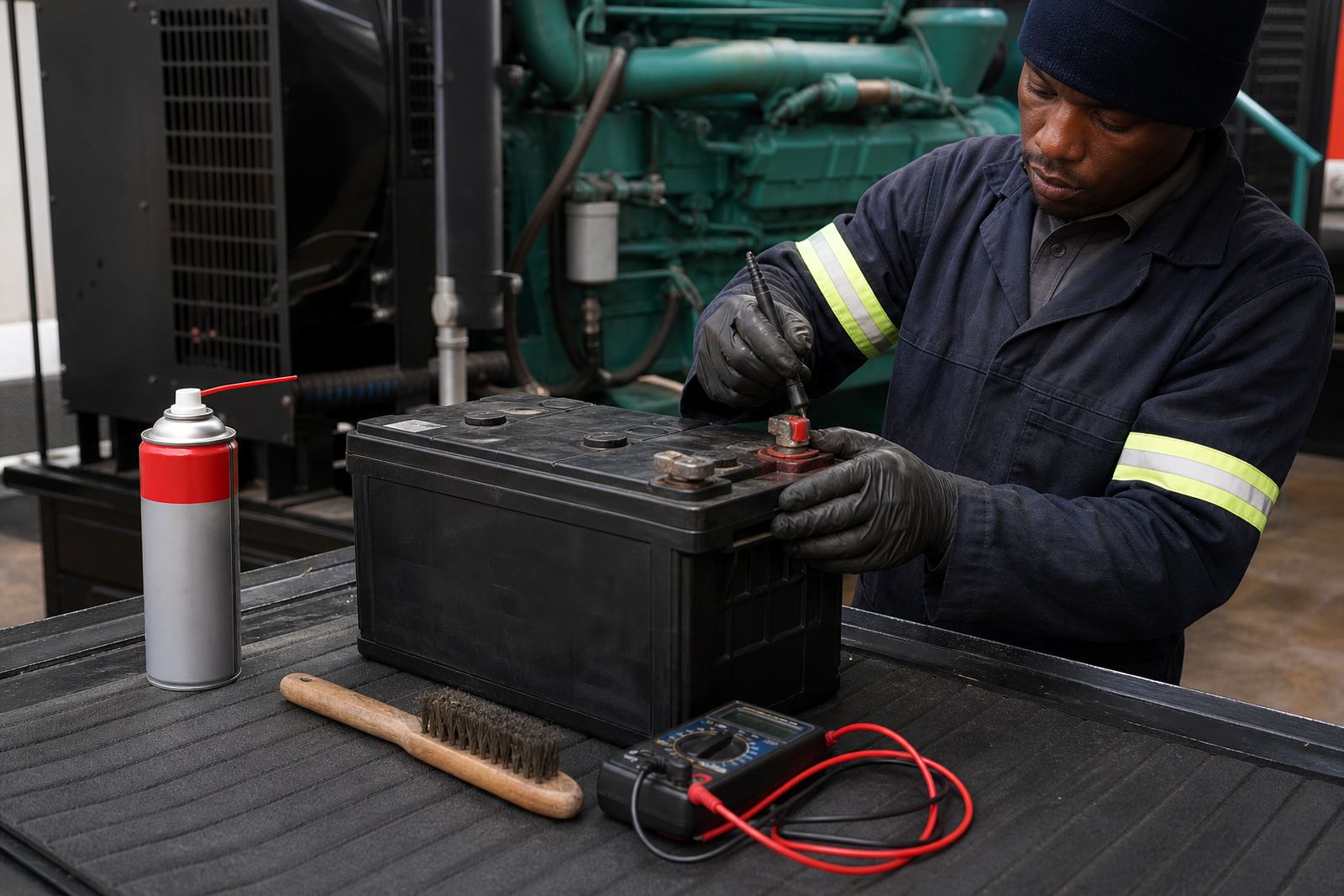
Battery care is more than wiping off dirt and moving on. A proper check looks at the whole starting circuit, from the battery condition right through to the charger and cable ends. On maintenance contracts, this should be part of scheduled servicing, with records kept for each site.
- Check battery voltage, resting condition and charging behaviour.
- Inspect terminals for corrosion, looseness and heat damage.
- Clean and tighten connections, then protect them against future corrosion.
- Confirm the battery tray, hold-downs and cables are secure.
- Test the charger output and verify it is maintaining the battery correctly.
- Look for swelling, leaks, cracks or any signs of overheating.
If a site has two batteries in a bank, both should be tested properly. A weak battery can drag the other one down and give a misleading result. That is one reason quick visual checks are not enough on their own.
Charging problems are often the real culprit
Many battery failures are blamed on the battery itself, but the real issue is the charging system. If the charger undercharges, overcharges or switches off when it should be on, the battery loses service life fast. This matters on standby generators that sit idle for long spells as well as prime units that run for long hours under changing loads.
Sites with unstable mains supply can also struggle after repeated power interruptions. Once the generator starts and stops often, the battery may never recover fully unless the charger is doing its job properly. Electrical work must be handled by qualified people under local regulations, and that includes any checks on control wiring, charging circuits and changeover related components.
Where a battery has failed more than once, the charger, cables and starting circuit should be inspected as a set, not one piece at a time. That approach saves time and avoids repeat callouts.
South African conditions that shorten battery life
Battery wear is not the same at every site. A generator in a cool inland plant room will face different conditions to one installed at a humid coastal facility in Durban or Cape Town. Heat shortens battery life, dust can settle on tops and terminals, and poor ventilation around the set can speed up deterioration.
Load-shedding adds another layer. A battery that only has to start the generator once in a while may still fail early if the charger is neglected. Prime power users often see the opposite problem: the battery is cycled more often and any weak cell shows up quickly during busy periods.
- Keep the battery area clean, dry and clear of loose metal objects.
- Do not store rags, grease cans or tools on top of the battery.
- Make sure the room or enclosure has enough airflow.
- Check for signs of acid mist or corrosion on nearby metalwork.
- Arrange periodic inspections before winter peak use or summer heat.
A practical example: a warehouse in Johannesburg may run fine for months, then fail to start after a long weekend because the battery charger had drifted off spec and the battery was already weakened by dust and heat. The fault only becomes visible when the site needs the set most.
Battery testing that tells you something useful
Good battery testing gives a clear picture of starting reliability, not just a number on a metre. A healthy battery can still fail under load, so the test should reflect real starting conditions. That is especially important for standby sets serving offices, clinics, retail centres and process sites that depend on instant start-up.
Testing should include more than voltage. A load-based check, along with inspection of the charger and cables, helps reveal batteries that look fine but collapse when called on. If the generator has been slow to crank, or the starter sounds laboured, the battery should be treated as suspect until proven otherwise.
Service records matter here. If one site keeps showing low battery readings every few months, there may be an underlying issue with the charger, storage conditions or operating pattern. Recording those findings makes the next visit more useful and helps the team spot a trend before it becomes a failure.
The changeover switch and the battery are connected more than people think
Battery care and changeover switch checks belong in the same conversation because both affect whether the generator actually takes over when the supply drops. If the switch is sticking, damaged or not operating as intended, the generator may be healthy but still not carry the load. In that situation the battery gets blamed unfairly when the real fault lies elsewhere.
During scheduled servicing, the changeover arrangement should be checked by qualified people under local rules, along with starter operation, control signals and any evidence of intermittent faulting. That is particularly important at commercial sites in Pretoria, Polokwane and the broader Gauteng area where a short outage can halt production, refrigeration or critical systems.
When battery care is linked with fault finding, service record audits and preventive site inspections, you get a clearer picture of the whole starting system. It also helps a site manager decide whether the issue is a one-off nuisance or a pattern that needs proper repair.
A practical maintenance habit for busy sites
The best battery plan is not complicated. It is regular, documented and tied to the rest of the generator service schedule. For many businesses, that means checking the battery at every planned visit, testing the charger, confirming start performance and recording any change in condition. Small faults get caught before they turn into a no-start callout.
That discipline matters on standby units that may only run during outages, and on prime sets that must keep working for long periods. If a battery is left untouched until it fails, the result is usually an avoidable outage, a rushed replacement and a lot of stress on the day. With proper servicing, the battery becomes one less thing to worry about.
RelGen supports maintenance contracts for businesses across South Africa from Midrand, with service teams active in Johannesburg, Pretoria, Durban, Cape Town and Polokwane. The aim is straightforward: keep the starting system dependable, keep records in order, and deal with small battery issues before they stop a set from starting.