Why a battery matters more than most people think
A generator battery does not work hard for long, but it must be ready every time the set is called on. In Midrand and across South Africa, standby units can sit through heat, dust, coastal humidity and load-shedding gaps, then fail at the worst moment if the battery has weakened.
For businesses that rely on diesel standby or prime power, battery health is not just a maintenance detail. It affects starting performance, alarm systems and the confidence you have in the whole installation. A battery can show no warning at all, then drop voltage quickly when the starter motor asks for current.
Electrical work should be handled by qualified people under local regulations, especially where battery chargers, control panels and changeover equipment are involved. That keeps the job safe and the records in order.
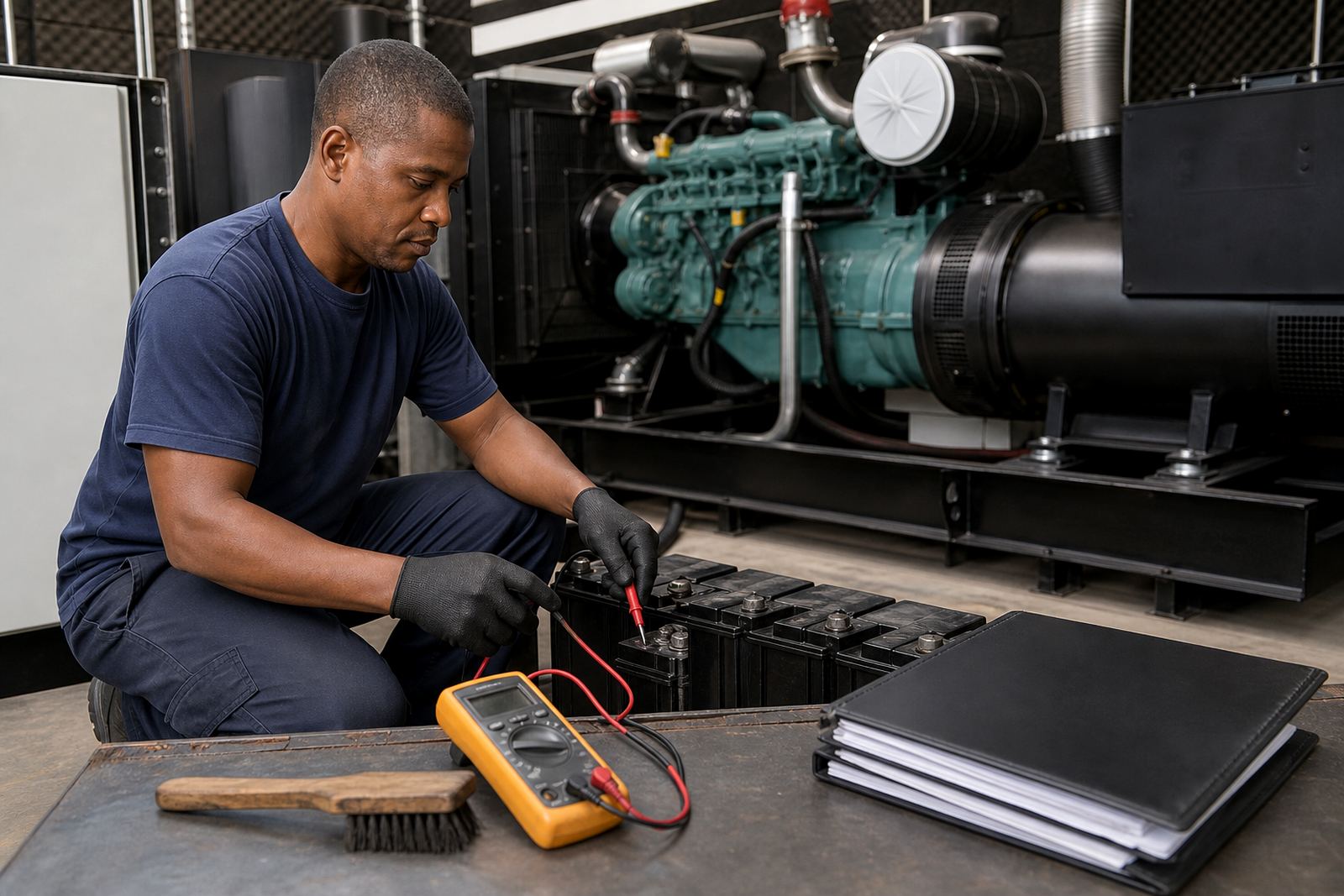
A practical battery check that can be done on site
Battery testing should form part of scheduled servicing, not only emergency repairs. A visual inspection is useful, but it is never enough on its own. The battery can look clean and still be too weak to start the unit under load.
- Check terminals for white or green corrosion, loose lugs and damaged insulation.
- Look for swelling, cracks or leakage on the battery case.
- Confirm the charger is operating and the float voltage is within range for the battery type.
- Test cranking performance, especially after long idle periods.
- Record the battery age, test result and any corrective work done.
In hot inland conditions, batteries can age faster than expected. On coastal sites, corrosion around terminals and frames can become a regular issue. If a battery is tested only once a year, trouble can go unnoticed for months.
Cleaning terminals without causing new faults
Dirty terminals and poor connections are common causes of starting trouble. Cleaning must be done carefully, because over-tightening or scraping parts too aggressively can damage the connection. A proper clean also includes checking the hold-down brackets, cable condition and terminal covers.
Before cleaning, isolate the system where required and follow the site safety procedure. Keep metal tools away from live terminals and never bridge connections with improvised items. A good service crew will clean the contact points, tighten the hardware to the correct level, and then confirm the charger and starter circuit are still behaving as expected.
It sounds minor, but a film of corrosion can increase resistance enough to cause slow cranking or a no-start event. That is why a battery can fail a service even when it still has charge left.
When replacement is due, not just when the battery dies
Many buyers wait too long before replacing a battery. They treat it as a consumable only after the set refuses to start. A better approach is to plan for replacement before the end of useful life, based on test results, age and operating conditions.
No fixed swap point suits every site. Hard duty cycles, weak charging, heat, shaking and dust all shorten service life. A unit that holds up well in a tidy office block may give trouble earlier on a building site or in a plant room with high ambient temperatures.
- Replace sooner if the battery fails load or cranking tests more than once.
- Replace if the casing shows swelling, leakage or cracking.
- Replace when charger faults have been left unresolved for too long.
- Replace if the battery age is unknown and service records are poor.
- Do not wait for a second failure after a clear warning sign.
For standby generators, one weak battery can mean a failed start and a costly delay. For prime units, repeated starting trouble can interrupt production and put stress on other starting components too.
What records should stay with the set
Good records make battery management easier and cheaper over time. They show patterns, help with warranty or service decisions, and make it simpler to spot a charger fault before it causes downtime. A tidy file is also useful when the site has more than one generator.
At minimum, keep the service date, battery voltage, test result, cleaning done, charger reading and the technician’s notes. If batteries are swapped between units or replaced during a fault finding visit, that should be written down clearly as well. A missing note today can become a repeated problem next month.
We also recommend keeping the battery make, model, installation date and disposal date in the service record. That helps managers plan stock and avoid last-minute sourcing when a unit is due for scheduled servicing.
A field checklist for busy sites in Midrand and beyond
Whether the set is in Sandton, Centurion, Durban, Cape Town, Polokwane or Pretoria, a simple checklist keeps battery care consistent. It also helps site managers compare one visit with the next, rather than relying on memory.
- Confirm the battery is secure and mounted correctly.
- Inspect terminals, cables and earth points for wear or corrosion.
- Test charger output and charging recovery after start-up.
- Check the battery age against the service file.
- Log any faults on the changeover switch, starter circuit or control panel that may affect starting.
- Follow up on repeated low-voltage readings instead of waiting for another callout.
For businesses with maintenance contracts, battery checks fit neatly into preventive site inspections and scheduled servicing. That gives you one clear view of the set, rather than separate reports with gaps between them. It also helps with load bank testing, because a battery that starts the generator properly is the first step before any testing under load.