The control panel is where the story starts
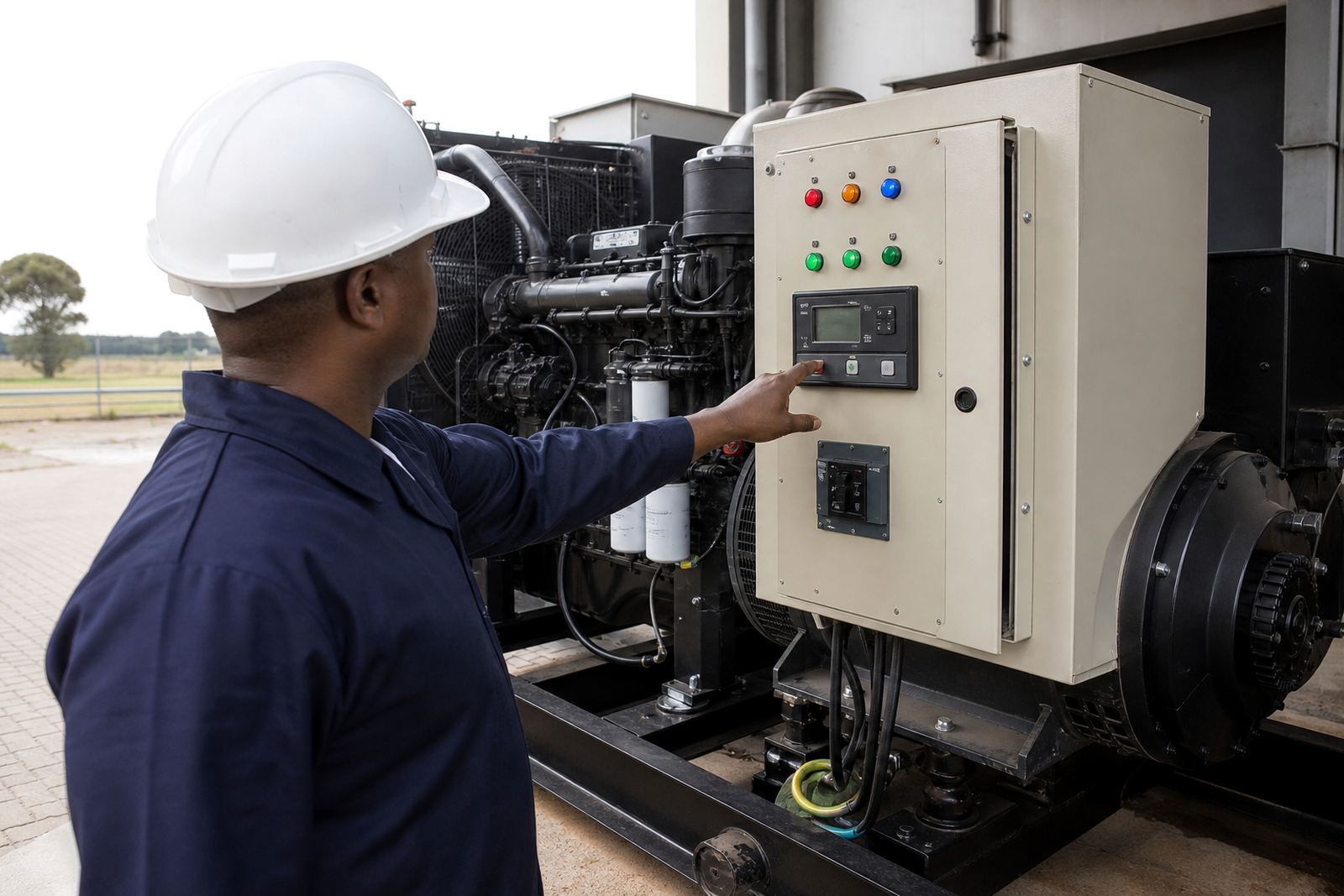
The control panel is the first place a technician looks when a generator does not start, trips under load, or shows an unfamiliar alarm. On standby and prime sets, the panel gives a clear picture of battery health, engine hours, shutdown history, transfer signals and whether the unit is ready for the next call to run. In Midrand, Sandton, Centurion and the wider Gauteng corridor, that quick read can save a business from a long outage when load-shedding or a local supply fault arrives.
Our control panel checks form part of scheduled servicing and maintenance contracts for business sites, from warehouses and office parks to plants, retail centres and construction compounds. We check the panel logic against the physical condition of the generator, then compare alarms and logged events with what the machine actually did on site. That helps find issues such as false low oil pressure trips, failed start attempts, weak batteries, missing feedback from the changeover gear or a fault that only appears after the set has warmed up.
Electrical work on control systems must be handled by qualified people and done to local rules and site requirements. We work carefully around live equipment and lockout procedures, then record what was checked, what was corrected and what still needs attention.
What gets checked on a panel service
A control panel check is more than pressing the start button and seeing a green light. We work through alarms, display readings, history logs and the operating sequence so the unit is ready for service when it is needed. If your generator is used as standby only, the focus is on readiness. If it runs as prime power, the panel also has to cope with longer duty cycles, repeated starts and site conditions that can be harder on relays, sensors and wiring.
- Alarm lamps, warning codes and shutdown indications
- LCD or digital displays, selectors and key switches
- Run history, event memory and fault logs
- Auto, manual and test mode functions
- Start, stop and emergency stop response
- Battery charger indication and low-voltage alarms
- Remote start and changeover signal feedback
When needed, we also compare the panel readings with oil pressure, coolant temperature, battery voltage and engine speed at the machine. That cross-check matters because a panel can look normal while a sensor, harness or connection is already becoming unreliable.
Options for different panel types and site setups
Control panels come in a range of arrangements, depending on the generator size, the age of the set and how the site is run. Some are basic start-stop panels with a small display, while others include deeper event memory, analogue gauges, automatic transfer interfaces and remote monitoring connections. On larger plants around Johannesburg, Pretoria and Durban, the panel may also form part of a wider control system tied into building services or process equipment.
Common options we encounter include panel layouts for single generator sets, dual set duty and standby arrangements, and units linked to automatic changeover switches. On a site with limited space, the panel may be mounted close to the alternator frame or integrated into an enclosure. On outdoor installations in Cape Town or along the coast, salt air and moisture can affect terminals, display windows and seals, so the condition of the enclosure matters just as much as the electronics inside.
- Panel-mounted or remote-mounted operator interfaces
- Basic alarm display or full fault memory systems
- Manual start arrangements or auto-start with transfer logic
- Single-set, multiple-set or synchronised site arrangements
- Indoor or weather-protected outdoor control enclosures
Where control panel checks fit best
These checks suit any business that depends on a generator to carry critical loads. We see the best value where the machine must start under pressure and cannot afford a failed command or a missed alarm. That includes manufacturing sites, clinics, farms, logistics yards, office buildings, body corporates and contract power rooms where the generator is tested regularly but still needs proper attention in between major services.
In hotter inland areas like Polokwane and Pretoria, batteries, relays and plastic fittings can suffer from heat and dust. In coastal areas such as Durban and Cape Town, damp air and corrosion can affect terminals and printed boards. A good panel check helps catch those problems early, especially where the generator sits idle for long periods and only runs when the utility supply drops away. On prime power sites, the panel has to stay accurate through longer operating hours and repeated shifts in load.
We also see panel faults after other maintenance has been done. A technician may change a battery, service a charger or carry out a changeover switch inspection, then the panel still shows an error because the alarm was not reset or the history was not cleared properly. A proper control panel check picks that up and leaves a clean record for the next service interval.
How the fitting or inspection is handled on site
Control panel checks are carried out on site, usually as part of a scheduled generator service or maintenance contract visit. Before any work starts, the unit is made safe in line with site procedures and local electrical requirements. The technician then confirms the actual panel condition against the machine condition and the service record, which is useful on units that have had previous callouts or partial repairs.
If a fault is found, the next step depends on the issue. A loose terminal, weak charger, failed indicator or corroded connector may be corrected during the visit if the site allows. A deeper fault in the control circuitry, wiring loom or interface with the changeover switch may need a return visit or parts supply. We do not leave a site guessing. The service record reflects what was tested, what was found and what still needs attention.
- Visual inspection of the panel face, seals and enclosure
- Functional test of start and stop commands
- Review of fault history and run hours
- Verification of alarm response and shutdown logic
- Check of battery charger indicators and control supply
Keeping the panel readable between services
Panel care is mostly about good housekeeping and timely attention. Keep the enclosure clean, dry and properly closed. Do not ignore a warning lamp just because the generator still starts. A repeated alarm often points to a wear item, a bad sensor or a supply issue that will only get worse. If the set is in a dusty or humid area, ask for the panel to be checked more often, particularly after storms, long idle periods or load-shedding events that cause frequent starts.
Service records help a lot here. When the run history is reviewed at each visit, patterns start to show, such as alarms appearing after cold starts, battery voltage dropping during extended testing, or a changeover input failing only under load. That kind of detail is useful for managing standby systems across Midrand, Johannesburg, Pretoria and further afield, where the generator may be one part of a bigger plant room or process setup.
Good panel care also means keeping the surrounding area clear so technicians can reach the controls, labels and isolators safely. A cluttered generator room slows down fault finding and makes it harder to spot heat damage, moisture ingress or a tripped signal that has been there for weeks.
What to confirm before you schedule a panel check
To prepare an accurate service visit, please confirm the generator make and model details from the machine plate, the panel type, and whether the set is standby or prime duty. It also helps to know if the unit is linked to an automatic changeover switch, whether there are multiple sets on the site, and what fault or alarm message is showing. If the site has an existing maintenance contract, have the latest service record ready so we can compare past readings with the current condition.
Useful details to confirm include the generator kVA rating, control panel arrangement, battery voltage, and whether the unit has local or remote start control. For larger commercial sites, it is also worth noting if the panel must coordinate with building systems, process equipment or a separate alarm network. That allows the technician to arrive with the right approach and saves time on site.
RelGen handles scheduled servicing, emergency callouts and preventive inspections for businesses across South Africa, from Midrand and Sandton to Durban, Cape Town and Polokwane. Our control panel checks sit neatly inside that work because a generator is only as reliable as the panel telling it what to do.
Key facts
| Service type | Control panel checks for generator maintenance contracts |
|---|---|
| Typical focus | Alarms, displays, run history and operating status |
| Generator applications | Standby and prime power units |
| Site fit | Commercial, industrial and multi-site business premises |
| Related systems | Battery chargers, changeover switches and remote start controls |
| Service area | Midrand, Johannesburg, Pretoria, Durban, Cape Town, Polokwane and surrounding business districts |