When the cranking sound changes, the fault is usually already there
Starter faults often begin with small signs that are easy to miss on site. A unit may crank slower than usual, struggle after a load shed event, or need several attempts before the engine fires. In some cases the relay chatters, the solenoid engages but the motor does not turn, or the battery voltage drops sharply as soon as the start command is given.
We inspect the full starting chain, not just the battery itself. That includes battery condition, terminal tightness, cable condition, isolators, starter motor operation, solenoid response, earth continuity and the control signal from the panel. On many sites around Midrand, Johannesburg and Centurion, the issue is a mix of poor cable terminations and weak batteries, not a single broken part.
- Slow cranking under no-load and loaded conditions
- Clicking at the starter relay or solenoid
- Repeated start attempts before ignition
- Battery voltage that collapses under load
- Heat damage, loose lugs, or corrosion on cables
What our starter system repair work covers
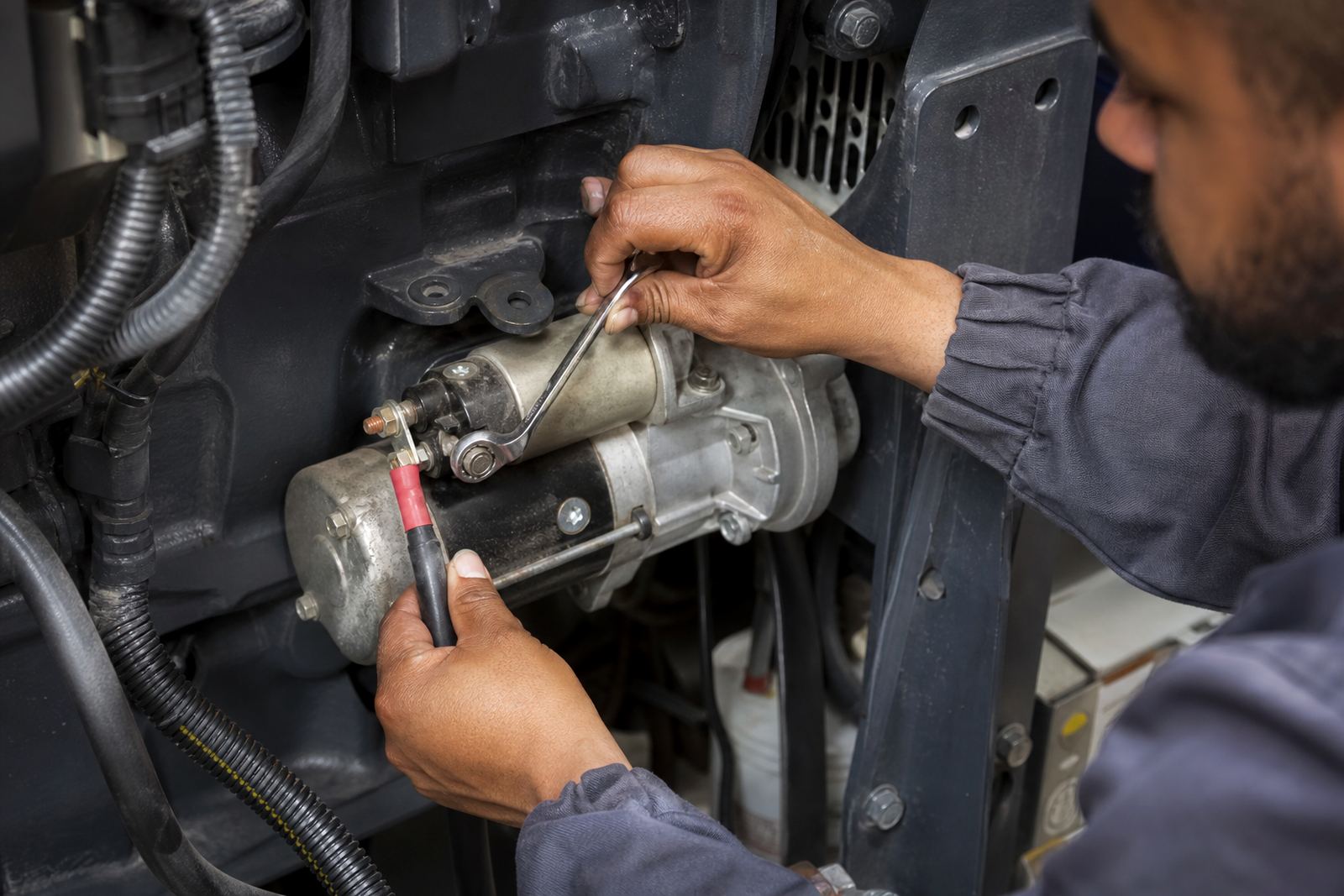
Starter system repairs are carried out on diesel generator sets used for standby support and prime duty on commercial and industrial sites. We work on the components that allow the engine to turn over reliably, including batteries, heavy-current cabling, starter motors, solenoids, relays and associated controls. If the fault is linked to the changeover sequence or the start command from the controller, we trace it through the control circuit as well.
Where the repair involves any electrical modification, replacement wiring or control work, it is handled by qualified personnel and aligned with applicable local regulations. That matters on sites with compliance requirements in Gauteng, coastal areas like Durban and Cape Town, and industrial plants that need clean records for audit and handover.
- Battery testing and replacement advice
- Starter motor inspection and bench checks where practical
- Solenoid and relay testing
- Cable repair, termination tightening and insulation checks
- Control circuit tracing from panel to starter assembly
- Starter engagement and disengagement checks after repair
How we trace a start fault without wasting your time
We start with a structured fault-finding process so the site team knows what is failing and why. First we confirm the symptoms during an actual start attempt or a simulated start sequence, then we measure battery state of charge, charging performance, voltage drop and starter draw. If the problem appears only after the engine has sat idle, we also check for sulphation, weak cells and parasitic drain.
Next, we inspect cabling, lugs, fuses, isolators and the starter control path. Corrosion at battery posts, loose earths and damaged cable sheathing can all create intermittent faults that are hard to catch during a quick visual check. On busy sites, that kind of fault can come and go, which is why we test under real conditions not just in the workshop.
- Visual inspection and fault confirmation
- Voltage and current testing on the starter circuit
- Battery load checks and connection checks
- Starter, relay and solenoid assessment
- Repair quotation based on actual findings
Turnaround that suits operational sites
For sites in Midrand, Sandton, Pretoria and Johannesburg, we prioritise fault calls where the generator is not starting at all, because that leaves the site exposed during outages. The turnaround depends on parts availability, access to the set, and whether the fault is in a serviceable item on site or a component that must be replaced. Simple battery and cable issues can often be resolved quickly, while damaged starter motors or control issues may take longer if parts need to be sourced.
We plan the job around your operating hours where possible, especially on plants, warehouses, medical sites and construction camps where work windows are tight. If the generator is a critical backup set, we will also discuss temporary risk controls while repairs are underway. That may include keeping the unit isolated until the fault is cleared, or testing the start sequence after business hours so no one is caught off guard.
- Emergency callout support where the unit will not start
- Planned repair visits for recurring cranking faults
- After-hours testing available on request
- Site coordination with facilities and electrical teams
How we price starter repairs on contract sites
Our pricing approach is based on the fault found, the labour required, and any parts that need replacing. We do not price a starter repair off guesswork, because the work can range from a cleaned terminal to a full starter motor replacement. Service contract clients in Gauteng and other provinces are handled according to their agreed scope, site access conditions and response requirements.
For non-contract or once-off work, we first confirm the fault, then outline the repair route so there are no surprises. If the job exposes further issues, such as heat-damaged cabling or a weak battery bank, those are reported before extra work is done. That way the decision stays with the client and the plant supervisor, not an assumption made in the field.
- Fault-based pricing, not blanket charging
- Labour and parts listed separately where needed
- Contract work handled under agreed service terms
- Additional findings reported before proceeding
Aftercare that keeps the next start from becoming a surprise
Once the repair is complete, we verify that the generator starts cleanly, the starter disengages properly and the charging system is supporting the batteries as it should. We also record what failed, what was replaced and what still needs watching. On sites with repeated faults, that record is useful for spotting whether the problem sits in the battery bank, the charging circuit, poor cabling or an operator issue.
Our aftercare can include a service record audit, a preventive site inspection and recommendations for any follow-up work on changeover switches or panel starting logic if those systems are part of the fault chain. We keep the feedback practical, because nobody on a site in Polokwane or Durban needs vague notes when the next outage arrives.
- Start-up verification after repair
- Recording of fault cause and remedial action
- Follow-up checks on related electrical components
- Advice for operators and site supervisors
Key facts
| Generator types | Standby and prime units used on commercial and industrial sites |
|---|---|
| Faults covered | Slow cranking, no-crank, click-no-start, intermittent start failure |
| Components checked | Battery bank, starter motor, solenoid, relay, cabling, earths, controls |
| Testing methods | Voltage drop testing, battery load checks, current draw checks |
| Compliance note | Electrical work handled by qualified people under local regulations |
| Service areas | Midrand, Johannesburg, Pretoria, Durban, Cape Town, Polokwane, Centurion, Sandton |